
Crisp County Criminal Court Records
A criminal court record is the court case file, not the booking sheet. In Crisp County, felony prosecutions are Superior Court matters in the Cordele Judicial Circuit. The Clerk of Superior & Juvenile Courts is the local court-record contact for Superior Court criminal files. Those files may include accusations or indictments, bond orders, arraignment entries, motions, plea forms, trial records, verdicts, sentencing orders, probation terms, restitution, fines, costs, and appeal notices.
Some misdemeanor and traffic-related criminal records may route through Probate Court or municipal court, depending on the charge and citation venue. Magistrate Court may appear early in the process through warrants, first appearances, and bond-related events. Juvenile criminal-type matters are handled in Juvenile Court and are restricted. A person researching the charge itself can use the separate Crisp County arrest records and court charges material, while the final case file belongs here.
Crisp County Criminal Court Channels
Criminal case access works by court and role. The District Attorney prosecutes state criminal cases in the circuit. The official county page names Brad Rigby as District Attorney, with office location at 510 South 7th Street, Suite 102, Cordele, phone (229) 271-4735, and fax (229) 271-4739. The defense side may involve private counsel or the public defender. The court clerk keeps the filed case documents, while the sheriff keeps jail, booking, and open-records material that is not the same as the criminal court file.
The Georgia Public Defender Council page for Crisp County is one of the manifest images assigned to Crisp County criminal court records.
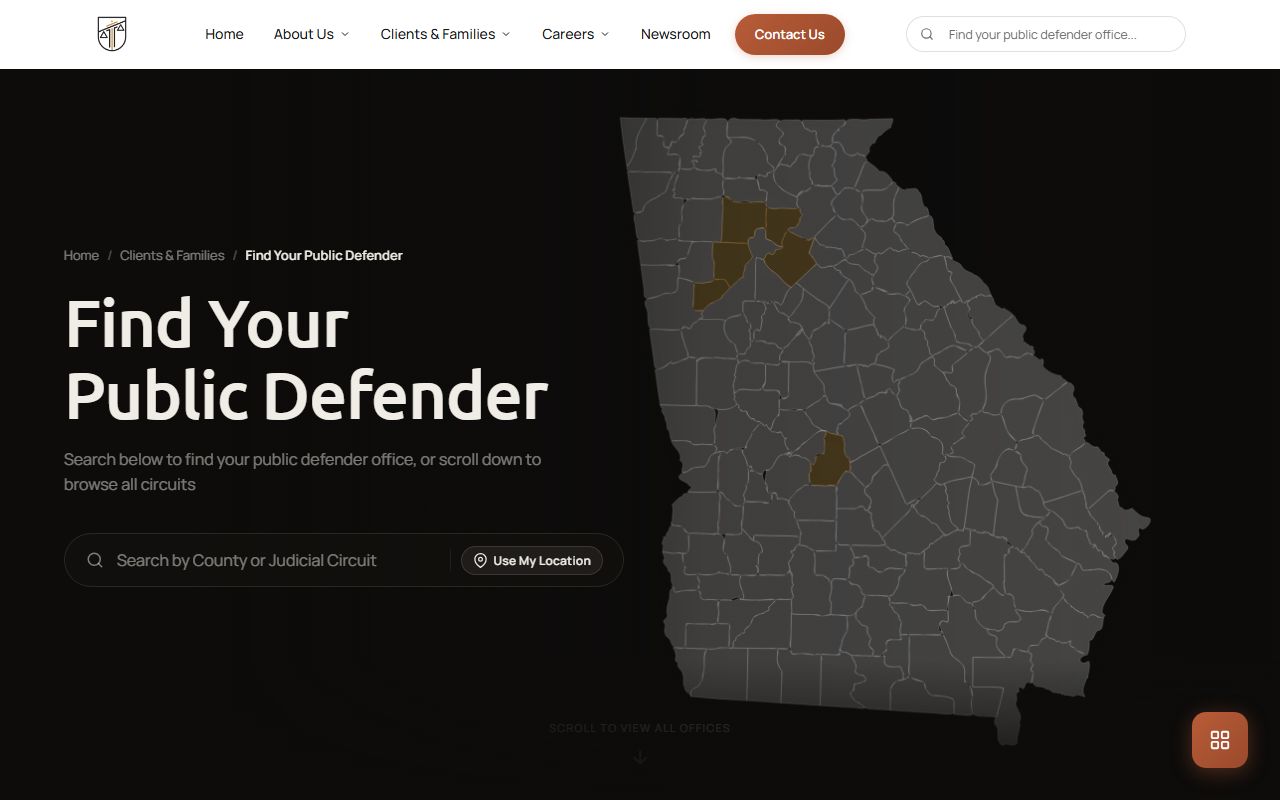
The public defender source helps place criminal court records in context because counsel information can appear in the court docket and case file.
| Office or Court | Criminal Record Role | Contact Route |
|---|---|---|
| Superior Court | Felony case file, arraignment, motions, plea, trial, sentence | Clerk of Superior & Juvenile Courts, (229) 271-4726 |
| District Attorney | Prosecution, formal charges, record restriction route after newer arrests | Brad Rigby, (229) 271-4735 |
| Probate Court | Traffic and certain misdemeanor violations | Probate Court, (229) 271-4731 |
| Magistrate Court | Warrants, first appearances, bond and early process records | Magistrate Court, (229) 271-4728 |
| Public Defender | Defense counsel for eligible defendants | Cordele Circuit public defender office through GPDC |
Search Crisp County Criminal Records
No official countywide Crisp County criminal case search was located. Start with the court that handled the case. For felonies, contact the Clerk of Superior & Juvenile Courts or use available statewide court-information portals if Crisp County records are visible. For misdemeanor traffic cases, call Probate Court or City of Arabi Court when the citation source points there. For a statewide felony conviction check, use Georgia Felon Search, but treat it as a criminal-history product rather than the full court record.
- Separate the need: full court case file, charge history, jail booking, statewide felony conviction check, or federal docket.
- For Superior Court cases, search by defendant name or case number where a portal is available, then verify with the clerk.
- For traffic or lower misdemeanor matters, contact Probate Court or the municipal court named on the citation.
- Ask for the docket, filed charging document, disposition, sentence, and certified copies if needed.
- Check restrictions before relying on juvenile, sealed, expunged, or record-restricted entries.
The Georgia Felon Search image is assigned to Crisp County criminal court records because statewide conviction checks are often confused with case files.
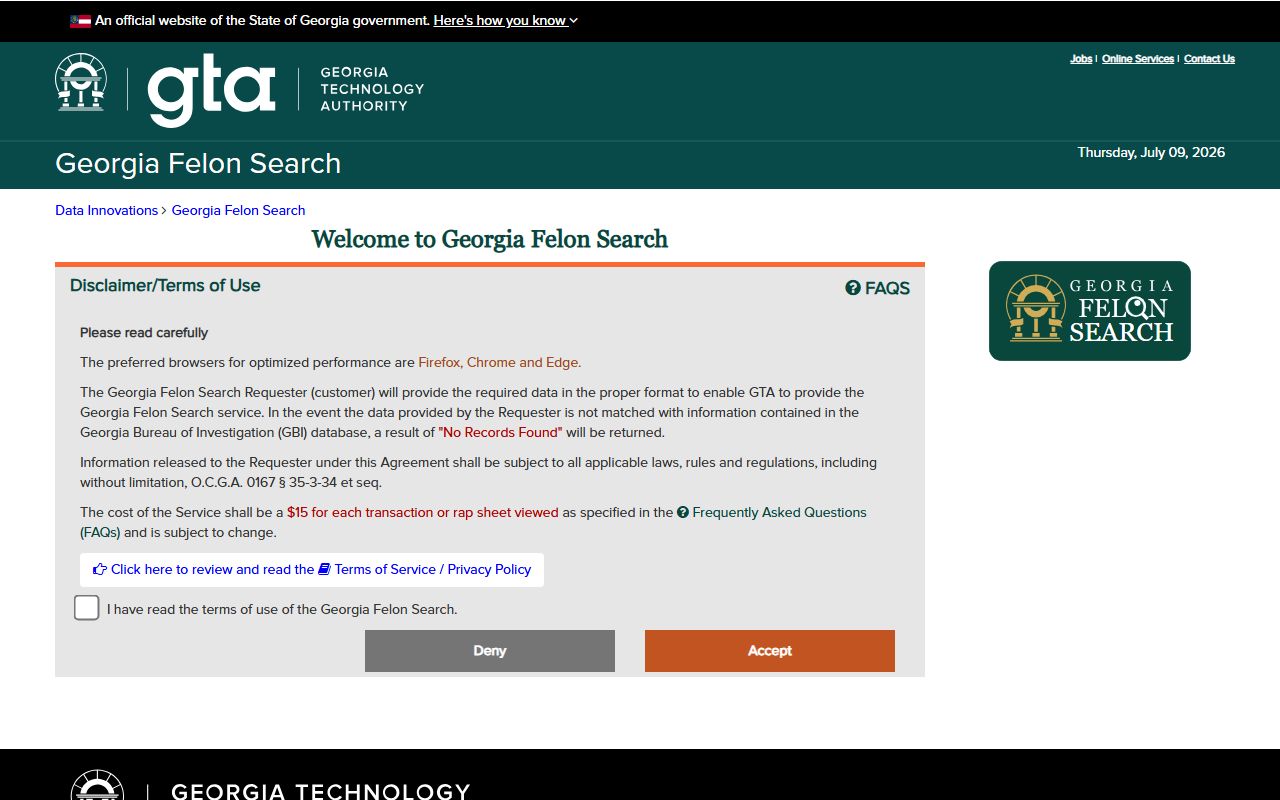
Georgia Felon Search may help confirm a felony conviction, but it does not replace the Crisp County criminal court record kept by the court.
Crisp County Criminal Case Flow
A criminal court record grows as the case moves through the system. Early records may show an arrest warrant, complaint, first appearance, bond, or preliminary step. Once the prosecutor files formal charges in court, the court file becomes the main record for what the prosecution alleges and how the case ends. The District Attorney is the key charging office for state criminal prosecutions in the circuit.
Case flow: Charges Filed › Arraignment › Pretrial and Motions › Plea or Trial › Disposition › Sentencing
| Stage | What the Criminal Court Record May Show |
|---|---|
| Charges filed | Accusation, indictment, count list, severity, statute, or charging language. |
| Arraignment | Entry of plea and notice that charges were formally presented in court. |
| Pretrial and motions | Bond orders, suppression motions, continuances, discovery notices, and hearing settings. |
| Plea or trial | Plea documents, jury trial events, bench trial entries, verdict, or negotiated resolution. |
| Disposition | Guilty, not guilty, dismissed, nolle prosequi, dead docket, or other outcome. |
| Sentencing | Confinement, probation, fines, costs, restitution, conditions, and appeal rights when present. |
What Crisp County Criminal Records Show
The criminal court record is field-based and document-based. The docket gives the timeline, while filed documents give the legal content. Crisp County research identified the expected fields from Georgia court systems and local court routing, even though an open sample Crisp County criminal docket was not available. The table below is a practical inventory for reading or requesting a criminal case file.
| Field | What It Shows |
|---|---|
| Case number | The local court number used by the clerk for lookup and copies. |
| Defendant | The accused person's name and available identifiers, with protected data redacted. |
| Prosecutor | District Attorney or other prosecutor of record. |
| Defense counsel | Private attorney or public defender listed for the defendant. |
| Charges | Counts filed by accusation, indictment, complaint, or amended charging document. |
| Bond | Bond amount, type, conditions, release status, or related orders when public. |
| Hearings | Arraignment, status, motion, plea, trial, sentencing, revocation, and appeal events. |
| Plea | Guilty, not guilty, nolo contendere, or plea withdrawal where shown. |
| Disposition | Outcome for the case or count, including dismissed, guilty, not guilty, nolle prosequi, or dead docket. |
| Sentence | Confinement, probation, fines, restitution, court costs, or special conditions. |
Charges vs Convictions
Charges and convictions are not the same. A Crisp County criminal court record may list charges that were amended, reduced, dismissed, dead docketed, or resolved by nolle prosequi. A conviction appears only after a guilty plea, nolo plea accepted by the court, guilty verdict, or another qualifying adjudication. Read the disposition for each count rather than assuming the first charge list is the final outcome.
| Point | Charge | Conviction |
|---|---|---|
| Meaning | An allegation filed or pursued in court | A final or accepted finding of guilt for a count |
| Where it appears | Warrant, accusation, indictment, docket, or prosecutor filing | Disposition, plea paperwork, verdict, sentence, or judgment |
| Can change | Yes, charges may be amended, reduced, dropped, or dismissed | Changes usually require post-judgment action, appeal, or restriction process |
| Search caution | Do not treat filing as guilt | Confirm count-level disposition and sentence |
Note: Count-level dispositions matter because one case can include charges with different outcomes.
Restricted Crisp County Criminal Records
Georgia uses record restriction for many criminal-history access issues. GBI's record restriction page explains that O.C.G.A. 35-3-37 governs many restriction routes and that the process differs based on arrest date. For arrests after July 1, 2013, the research says the person contacts the prosecutor rather than using the older arresting-agency process. For arrests before July 1, 2013, the person applies through the arresting agency.
The GBI record restriction source is assigned as a manifest image for Crisp County criminal court records.
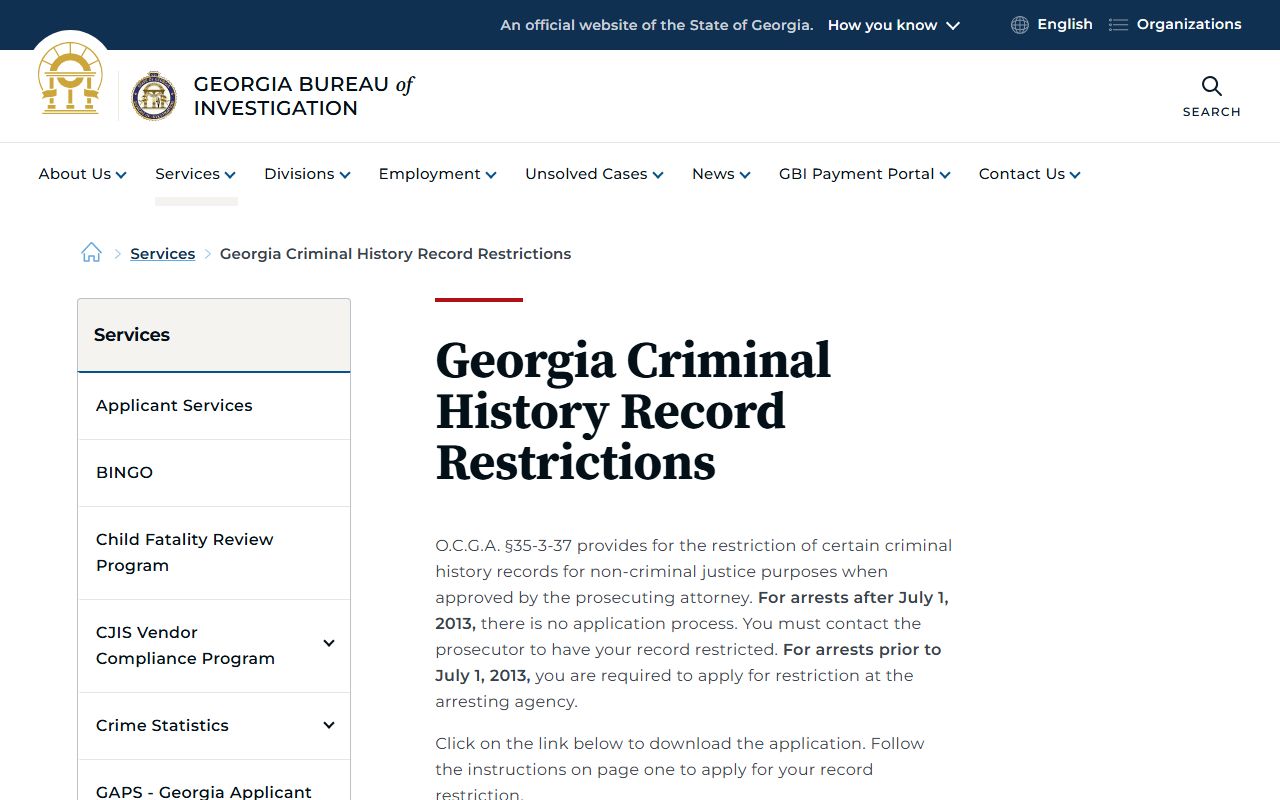
That state process limits public criminal-history access in eligible cases, but it should not be confused with editing a court docket or sealing a case file.
| Point | Sealed | Record Restricted |
|---|---|---|
| Main effect | Court limits access to a file, document, or entry | Public criminal-history access is limited for eligible records |
| Source | Court order, rule, statute, or protected case type | Georgia criminal-history restriction law and agency or prosecutor process |
| Examples | Juvenile, adoption, mental-health, sealed filings, protected personal data | Eligible arrests or dispositions under O.C.G.A. 35-3-37 |
| Where to ask | The court clerk or judge's office for case-file access | District Attorney, arresting agency, or GBI route depending on the record |
Case File vs Criminal History
A full criminal court record and a criminal-history report answer different questions. The case file shows what happened in court. It may include motions, orders, pleas, verdicts, dispositions, and sentence details. A GBI criminal-history product or Georgia Felon Search result is designed for statewide criminal-history access, not for reading every document in the court case.
The GBI criminal-history FAQ says public felony conviction access requires full name, race, sex, and date of birth under the cited Georgia criminal-history access law. That is a different search design than a court clerk request, where a case number, filing date, court, and defendant name are often the best fields. Do not use a criminal-history check as proof that no court case ever existed.
The GBI criminal-history FAQ image is assigned to this Crisp County criminal court records page.
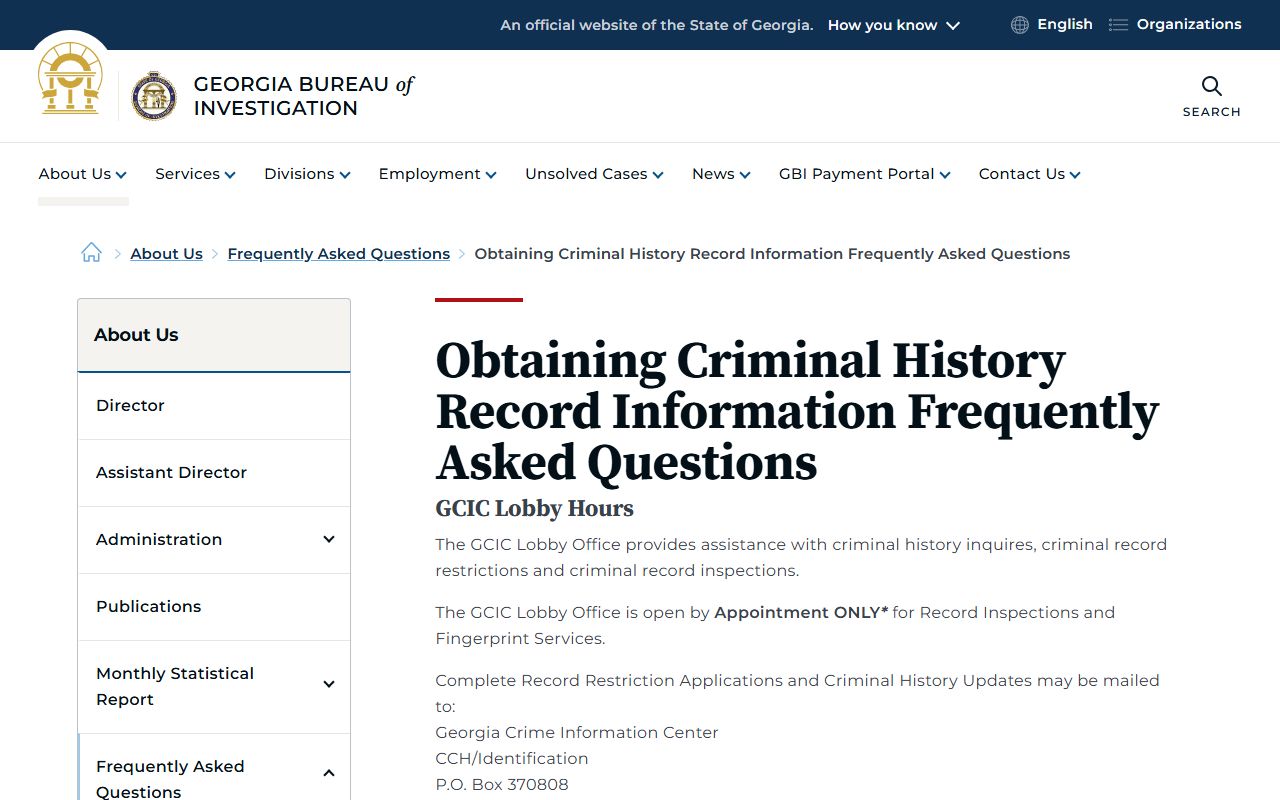
The FAQ supports the distinction between statewide conviction lookups and the actual Crisp County criminal case file.
DA and Defender Details
The prosecution and defense offices can matter when reading Crisp County criminal court records. The District Attorney's office files or pursues state criminal charges and is also the contact path noted by GBI for many newer record-restriction questions. The official county page lists Brad Rigby as District Attorney for Crisp County. The public defender source is important for defendants who qualify for appointed counsel and for docket entries that show defense representation.
The research file also notes a Georgia Public Defender Council announcement naming Kyle Hollomon as Circuit Public Defender for the Cordele Judicial Circuit effective December 16, 2024. That office detail may help explain a defender name or office contact in a criminal case file. Representation data in a docket does not prove the outcome of the charge. It only identifies counsel or office involvement at that stage.
The Cordele Circuit public defender announcement is the final manifest image assigned to Crisp County criminal court records.
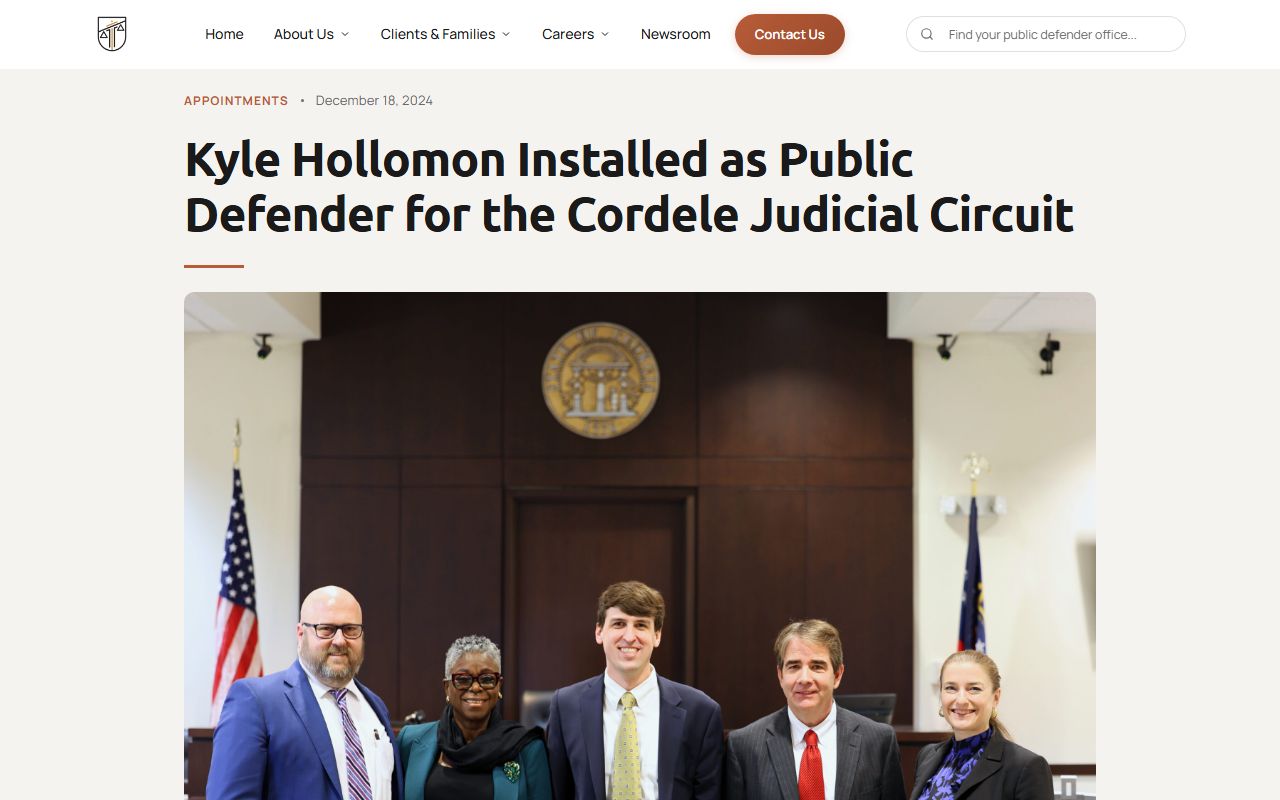
That public defender announcement supports the local defense context without changing which court keeps the criminal case record.
Public Access to Crisp County Criminal Records
Criminal court records are generally public unless a law, court rule, redaction requirement, or sealing order limits access. Georgia's public-records policy appears in O.C.G.A. 50-18-70, while exemptions appear in O.C.G.A. 50-18-72. For court records, court rules and the clerk's procedures also matter. Juvenile records, sealed files, protected identifiers, mental-health materials, and some restricted criminal-history records may not be open to the public.
Ask the clerk for the available copy type before paying. A plain copy may be enough for reference. A certified copy may be needed for legal, licensing, immigration, employment, or agency use. Local copy and certification fees were not located in the official Crisp County pages reviewed, so the amount should be confirmed with the office at the time of request. If a file is sealed, the clerk may require a court order or proof that the requester is a party or authorized person.
Important: Public criminal court records are not consumer reports and should be verified with the originating court before legal use.
Request Crisp County Criminal Case Copies
A strong copy request gives the clerk a clear lookup path. Include the defendant's full name, case number if known, filing year, charge or case type, copy type, and whether certification is needed. If the record may involve a juvenile, sealed matter, or restricted charge, ask what access proof is required before submitting payment. For a statewide conviction check, use Georgia Felon Search or GBI channels. For custody status, use jail or VINE channels instead of the court case file.
Clerk of Superior & Juvenile Courts
510 7th Street North
Cordele, GA 31015
(229) 271-4726
8:30 a.m. to 5:00 p.m.
District Attorney
510 South 7th Street, Suite 102
Cordele, GA 31015
(229) 271-4735
8:30 a.m. to 5:00 p.m.