
Crisp County Probate Court Scope
Crisp County Probate Court is the dedicated probate venue for the county. The official page states that Judge Amber Roberts presides. The court exercises jurisdiction over administration of estates of deceased persons, appointment of guardians and conservators for minors and incapacitated adults, involuntary evaluation of persons suffering from mental illness or abusing drugs or alcohol, traffic and certain other misdemeanor violations of Georgia law, marriage licenses, concealed firearms licenses, and other licenses or permits.
That broad jurisdiction means not every Probate Court file is an estate file. A probate records request should name the record type first: estate, will, letters testamentary, administration, guardianship, conservatorship, marriage license, weapons carry license, or involuntary evaluation. The correct label helps court staff determine whether the file is public, restricted, available by copy request, or subject to special handling.
Crisp County Probate Court
Judge Amber Roberts
Crisp County Courthouse
510 N 7th St, Suite 101
Cordele, GA 31015
P.O. Box 26, Cordele, GA 31015
(229) 271-4731
Fax: (229) 271-4716
9:00 a.m. to 5:00 p.m., Monday-Friday
Crisp County Probate Terms
Probate files use terms that differ from ordinary civil case records. The terms below are useful when calling Probate Court, reading an order, or asking for a certified copy. They also help separate an estate file from a guardianship, a conservatorship, or a license record.
- Testator
- The person who made a will.
- Executor
- The person named in a will to carry out the estate duties after appointment.
- Administrator
- The person appointed to handle an estate when there is no will or no executor can serve.
- Intestate
- Dying without a valid will.
- Guardianship
- A court arrangement for personal care or decisions for a minor or incapacitated adult.
- Conservatorship
- Court-appointed financial management for a protected person.
Crisp County Estate Records
Estate records can include an original will, petition to probate will, petition for letters testamentary, oath, bond, order admitting will, and letters testamentary. When there is no will, the file can include a petition for administration, heirs list, consent or acknowledgment, notices, order appointing administrator, and letters of administration. Later filings may include inventory, appraisement, annual returns, petitions to sell property, creditor notices, discharge, and closing documents.
The court file should be searched by decedent name and, when known, estate or case number. Date of death is useful because it helps staff locate the right year and avoid confusion with similar names. A certified copy of letters testamentary, letters of administration, or an order may be needed for banking, title, property, insurance, or estate administration tasks.
Crisp County Guardianship Records
Probate Court handles appointment of guardians and conservators for minors and incapacitated adults. These files may include petitions, evaluations, orders, accountings, and later reports. They are not always open in the same way as routine estate filings because they can involve minors, medical facts, disability, personal finances, and protected-person information.
When requesting a guardianship or conservatorship record, identify the ward or proposed ward, the petitioner, the approximate filing year, and the specific document needed. Ask the court whether the document can be released, whether redaction is required, and whether a certified copy is available. If the file involves an adult's capacity or a child's personal information, expect a narrower access path than for a simple public estate order.
Note: Minor-related and incapacity records may require court review before inspection or copying.
Search Crisp County Probate Records
No Crisp County online probate case search was located in the official sources reviewed. The access path is therefore practical and office-based: call Probate Court, visit Suite 101, or mail the request to P.O. Box 26. A request should say whether it seeks a plain copy, certified copy, filing search, or status check. The court can also confirm whether a file is public, restricted, archived, or not in Probate Court at all.
Probate Court is the first stop for estates, guardianships, conservatorships, marriage licenses, weapons carry license questions, and involuntary evaluation matters. It is not the records office for Superior Court divorces, felony cases, real estate indexes, or sheriff open-records requests. If a name search does not locate the file, ask whether the matter belongs with the Clerk of Superior & Juvenile Courts, Magistrate Court, City of Arabi Court, the Sheriff's Office, or a state agency.
Use the following fields before calling or mailing a probate records request. They are based on the research file's probate search-field table and are designed for a no-online-search environment.
| Field Label | Type | Required | Options or Format Notes |
|---|---|---|---|
| Decedent name | Text | Yes for estate lookup | Use full legal name and include aliases or maiden name if known. |
| Estate or case number | Text | Optional | Best lookup field if known. |
| Date of death | Date | Optional | Helps locate the estate by year. |
| Record type | Choice | Optional | Will, estate administration, guardianship, conservatorship, marriage license, or weapons carry. |
| Applicant or ward name | Text | Varies | Useful for guardianship, conservatorship, or license records. |
| Copy type | Choice | Yes for copy request | Plain, certified, or exemplified; fees were not located. |
Crisp County Probate Process
The probate process depends on whether there is a will, whether heirs consent, whether a fiduciary needs appointment, and whether the matter involves an estate, guardianship, or conservatorship. The research gives a practical estate workflow for Crisp County Probate Court. Exact forms and fees should be confirmed with the court before filing.
- Determine whether there is a will and identify the correct petitioner.
- Contact or visit Probate Court at 510 N 7th St, Suite 101.
- File the correct petition with death certificate, will if any, heirs or beneficiaries, proposed administrator or executor information, and required oath or bond when applicable.
- Complete notice requirements and any required newspaper publication or consent process.
- Attend the Probate Court hearing if required.
- Receive letters testamentary or letters of administration if appointed.
- File inventory, returns, accountings, petitions for sale, or discharge documents as required.
- Request certified copies of orders or letters from Probate Court when needed.
Crisp County Probate License Records
Probate Court also handles marriage licenses and concealed firearms or weapons carry licenses. Marriage-license records are different from estate records, but they are still part of the Probate Court's office functions. A marriage request should include applicant names, approximate license date, ceremony date if known, and the type of copy needed. For a deeper look at the marriage and divorce split, see Crisp County marriage and divorce records.
Weapons carry license applications may have access limits. The research file does not identify a public online weapons-license lookup for Crisp County. A request involving a weapons carry license should be directed to Probate Court, and the requester should expect the court to apply any state-law privacy, safety, or licensing restrictions before releasing information.
License records should not be mixed with estate search terms. A marriage-license request is usually searched by applicant names and license date, while a weapons carry question may require the applicant to work directly with court staff under licensing rules. Using the right record type at the start helps avoid a false no-record response.
Crisp County Probate Fees
A local probate fee schedule was not located in the official sources reviewed. The Probate Court page gives the court phone number, office address, and payment cutoff, but the reviewed page did not publish amounts for estate petitions, letters, certified copies, guardianship applications, or other probate filings. Probate Court also states that no payments are accepted after 4:30 p.m.
| Item | Amount or Rule Found |
|---|---|
| Original probate application | Fee not located in official sources reviewed. |
| Letters testamentary | Fee not located in official sources reviewed. |
| Letters of administration | Fee not located in official sources reviewed. |
| Certified copy per page | Fee not located in official sources reviewed. |
| Guardianship or conservatorship application | Fee not located in official sources reviewed. |
| Payment timing | No payments accepted after 4:30 p.m. |
Restricted Crisp County Probate Files
Not every Probate Court record should be treated as a public estate file. Guardianship records, conservatorship records, mental-health or substance-abuse evaluation files, minor-related material, and weapons carry data may be restricted or redacted. The Probate Court's jurisdiction over involuntary evaluations is especially sensitive because those records can include health and capacity information.
A person requesting a restricted or partly restricted file should ask for the public order, docket entry, or certified appointment document rather than demanding the entire file. That narrower request may let court staff release a public portion while protecting medical facts, financial identifiers, minor information, or sealed material. If access depends on party status, guardianship role, attorney authority, or a court order, Probate Court can identify the next procedural step.
Georgia public-record access rules favor access to public records, but exemptions, court rules, and privacy laws can limit release. The source image captured from the Georgia DDS open-records page is not a probate search tool, but it illustrates an important statewide point for Crisp County records: agency files and court files use different open-records channels.
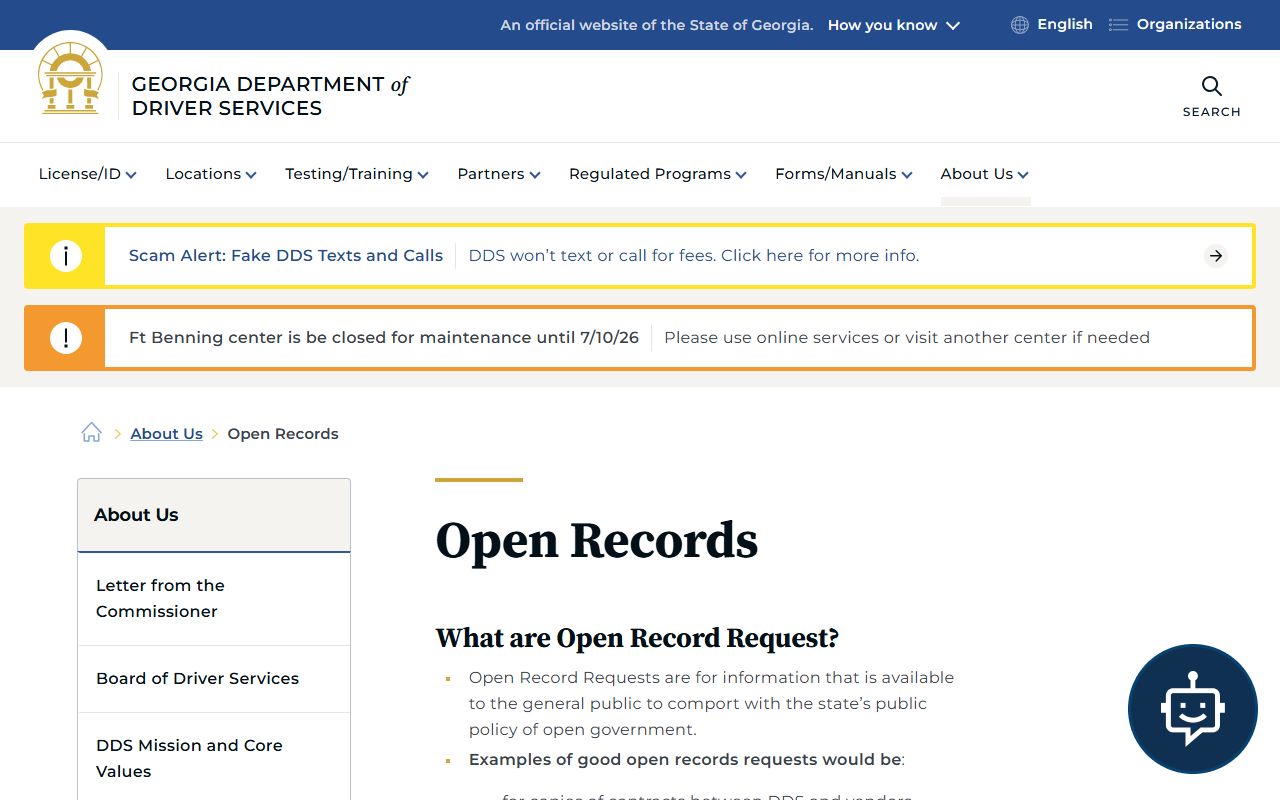
For Probate Court records, the correct channel remains Probate Court itself, while driver-license records, law-enforcement records, and Superior Court records must be requested from their own offices.
Note: A file can be partly public and partly restricted, so ask for the specific order or copy type needed.